
The Landscape Architect of the Future: Learn to Design, Create Value — and Don't Stop There

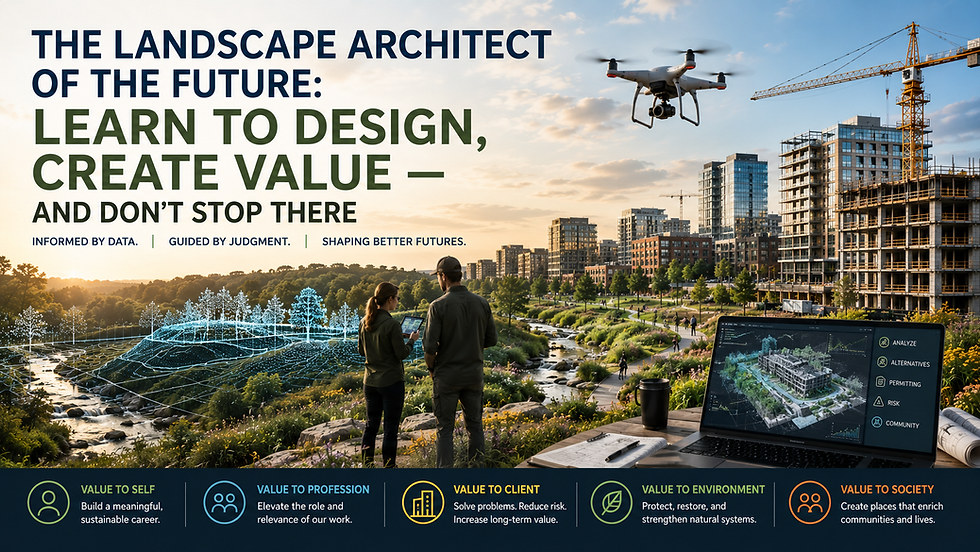
I once spent three full days measuring a two-acre site by hand — tape, string line, a lot of squinting at contours. A student today can put a drone over that same site before lunch and have a point cloud accurate to the centimeter by the time they're back at their desk.
That's not a complaint. It's the whole point of this article.
I've watched this profession get faster three or four times over in thirty years. CAD let a five-person firm do what used to take ten. GIS, 3D modeling, and cloud rendering kept pushing that number down. Drones, LiDAR, and photogrammetry changed field documentation the same way. None of it eliminated landscape architects. It just meant fewer of us were needed to produce the same amount of drawing.
AI is about to do that again, only bigger. I think one or two experienced, technologically fluent practitioners may eventually produce what used to take a team of ten, fifteen, twenty-five people.
That does not mean the profession disappears. It means the work of producing things gets cheaper and faster — and the real question for anyone entering this field right now is: if production stops being scarce, where does your value come from?
That's not really a question about AI. It's a question our profession should have been asking all along.
Stop Confusing Production With Value
Here's the trap. We tend to think our value is the drawing — the forty hours it took to produce a planting plan, a grading plan, a master plan. But imagine AI lets an equally competent practitioner produce that same plan in eight hours. Did the value just drop 80 percent?
No. If that plan prevented a $250,000 drainage mistake, saved a stand of mature oaks, or got a project through entitlement that would've stalled otherwise, the value was never really the forty hours. The hours were just how the value got delivered. Same thing with fieldwork — the value was never how many hours you spent walking a site with a tape measure. It's knowing what information you actually need, whether it's reliable, and what it means once you have it.
As technology compresses production time, we have to get comfortable measuring ourselves by what our involvement changes, not by how long it took us to change it. That's a real shift, and it's worth sitting with.
Learn to Design. Then Move Upstream.
Design still matters. Grading, drainage, plants, materials, construction, spatial composition — that foundation isn't going anywhere, and no software replaces it. But being able to produce a competent plan doesn't distinguish anyone the way it used to. Plenty of tools can now put a decent-looking plan in front of a homeowner or a developer without a landscape architect anywhere near it.
So the better question stops being can you design this and becomes: what does your judgment add that the software can't?
Most of us get handed a project after the important decisions are already made — the site's bought, the road's located, the buildings are sited, engineering's underway, and somebody asks us to make what's left over look nice. There will always be a place for that. But the decisions that create real value — or real cost — happen earlier. Which piece of the property gets developed and which gets preserved. How drainage and topography should shape the master plan in the first place. Why weren't we in the room for that?
Learn due diligence. Learn site selection and development feasibility. Learn entitlements and land-use policy. The farther upstream you move, the more your judgment actually shapes the outcome instead of decorating it.
Move Outward, Too — But Know Your Lane
At the same time, get fluent in the disciplines sitting next to yours. Not so you can pretend to be an engineer or an attorney — professional boundaries exist for good reasons, and knowing how to fly a drone doesn't make you a licensed surveyor. But learn enough hydrology to know water doesn't care where the property line is. Enough development economics to know when your beautifully sustainable recommendation just made the project impossible to finance. Enough regulation to spot a permitting problem before it becomes a six-month delay. Enough construction to know whether your idea can actually get built.
The practitioner who understands how these pieces connect creates value that no single technical silo can produce on its own.
Communicate the Value You Create
It's not enough to create value — people have to understand you created it, and honestly, our profession is bad at this. We describe activities: we prepared a master plan, we designed a stormwater-sensitive site. Clients don't buy activities. They buy outcomes.
"I designed a stormwater-sensitive site plan" doesn't land. "We reorganized the site to work with the natural drainage, cut unnecessary grading, and lowered the engineered infrastructure the project needed" does. That's not self-promotion — it's professional education. If nobody understands what changes because a landscape architect was in the room, don't be surprised when people start asking why one is necessary.
That same instinct applies to the people who disagree with you. A neighbor who says "I oppose this development" is often really saying I'm worried about flooding or I don't want to lose that tree line. Those are solvable problems, sometimes. Learn to hear the difference between someone's stated position and what they're actually afraid of — and be willing to admit when they're right.
Judgment Is the Scarce Resource Now
Here's the part that changes everything. The developer will have AI. So will the engineer, the environmental group, the planning department, and the neighborhood association pushing back on your project. Once everyone at the table has the same research assistant, information stops being scarce.
Judgment becomes scarce.
Somebody still has to sit at that table and say: this matters, this doesn't. The neighbors are right about this one. This is technically possible but a bad idea. Here's what I think we should do, and here's why. AI can hand you twenty alternatives. It can't tell you which one you'd be willing to defend in a public hearing. That's still you.
The Problem Nobody's Solved Yet
I'll be honest about the part that keeps me up at night. Most of us who have that judgment now built it by doing the very production work AI is about to automate — years of drawing, measuring, revising, watching things fail on a job site. If entry-level production work disappears, how does a young practitioner accumulate thirty years of judgment when the traditional path to get there just got a lot shorter?
I don't have a clean answer. But mentorship is going to matter more, not less. Field time is going to matter more. Firms and schools need to start asking this question now, before the shortage of judgment shows up and surprises everyone.
Find Your Specialization
If fewer people can produce more of the work, get known for something. Ecological restoration, coastal resilience, healthcare landscapes, urban design, development strategy — whatever it is, build real depth in it rather than staying a generalist who's fine at everything and exceptional at nothing.
My own version of that has become something I call Development Stewardship — pulling together land, environment, economics, regulation, and community interest to help people make better decisions about how land changes, well before anyone's drawing a planting plan. That's my direction. It won't be everyone's. Find yours.
What I'd Tell a Student
Learn design, plants, grading, drainage, construction — the craft. Don't stop there. Learn how development gets financed. Learn regulation, negotiation, public speaking, writing. Get on job sites and talk to contractors, developers, and the people who disagree with you. Learn drones, GIS, LiDAR. Learn AI — aggressively, not casually — and never confuse its output with your judgment.
And keep asking yourself one question, on every project: what value am I actually creating — for the client, for the environment, for society, for the profession, and yes, for myself. You won't max out every category every time. That tension is exactly why the judgment matters.
Where I Think This Is Actually Headed
I don't say any of this out of worry for the profession. I say it because I think what's coming is the best version of landscape architecture we've ever had.
The generalist model — a little bit of everything, competent across the board, distinguished by none of it — was always somewhat of a compromise, a byproduct of how much raw production a person had to grind through just to stay employable. Take that burden off the table, and something better gets to emerge. The next generation of landscape architects won't need to be generalists. They'll be experts — genuinely deep in soils, water, ecology, restoration, coastal systems, whatever they choose — freed up by their tools to spend their finite human attention on judgment instead of production.
And that expertise arrives at exactly the moment we need it most. We are, whether we fully admit it yet, in the early stages of figuring out how mankind actually lives in lasting harmony with the natural systems that support us — not managing decline, not merely minimizing damage, but genuinely understanding how growth, ecology, water, and land can function as one system instead of five competing interests. That is landscape architecture's native language. No other profession sits closer to that question.
I'll go a step further, and I mean this seriously, not as a flourish. I think the practitioners entering this field today are training for something larger than most of them realize. Every closed ecological loop we learn to design on this planet — every system where water, soil, air, and life stay in balance inside a defined boundary — is also, in miniature, a rehearsal for building environments where none of that exists to begin with. Somebody is going to have to design the landscapes of an interplanetary age: engineered biospheres, closed-loop life support, soil built from scratch, water and habitat sustained entirely by human judgment rather than by billions of years of planetary inheritance. That future is closer than most of us imagine, and it will need people who think exactly the way landscape architects are trained to think — about land, systems, water, life, and the relationships between them.
Learn to design. Learn to think. Learn to create value. Become an expert, not a generalist. Because the next generation of landscape architects isn't just inheriting this profession.
They may be the ones who carry it to the next world.
~ Eric


The jump from three days of hand-measuring to a centimeter-accurate point cloud captures how quickly the landscape architect’s toolkit is changing. The real value is knowing what to do with that data. I’ve been using https://planable.online
The shift from three days of hand-measuring to a centimeter-accurate drone point cloud captures how quickly the craft is changing—while practical judgment still creates the value. I’ve been using https://vidnoz.pro/what-is-vidnoz-ai
The shift from three days of hand-measuring to a centimeter-accurate point cloud really captures how the landscape architect’s role is evolving. The challenge is turning better data into better value—I’ve been using https://vidu-ai.pro
The contrast between three days of hand-measuring and a drone-generated, centimeter-accurate point cloud makes the shift in practice feel tangible. I’ve been using https://hyper3dai.pro
The shift from three days of hand-measuring to a centimeter-accurate point cloud really captures how the landscape architect’s role is evolving from drafting plans to creating broader value. I’ve been using https://ai-api.art/ai-api-examples