

Landscape Software Is Not Landscape Design

Updated: Mar 5
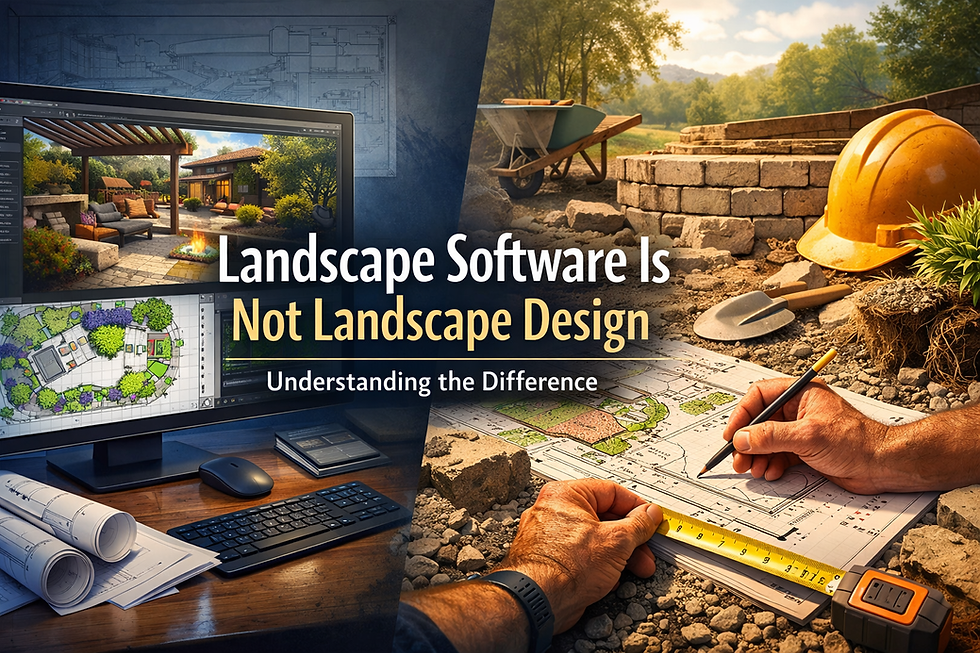
Why computer generated images should not be confused with professional judgment
I have nothing against landscape software (or AI for that matter). I use it. I appreciate it. I have watched it evolve from basic drafting tools into impressive programs that can produce beautiful plans, three dimensional models, and polished renderings that look like photographs. In many ways, this technology has made it easier to communicate ideas and help clients visualize possibilities.
But I have also watched a growing misconception take hold in our industry.
Somewhere along the way, a lot of people started confusing the tool with the work itself. They began treating a computer image as proof of design skill, and they began assuming that if something looks good on a screen, it must be a good solution in real life.
That is not how landscapes work.
Landscape design and landscape architecture are not defined by the software used to draw them. They are defined by the thinking behind them, the decisions made before the first line is drawn, and the responsibility to create an outcome that can actually be built, will perform in the real world, and can succeed over time.
Software draws lines, but design solves problems
Most landscape software applications are excellent at drawing objects. They can place plants, patios, walls, steps, lighting, irrigation components, and furniture into a digital environment. Many programs can calculate quantities, create clean plan graphics, and generate views that are easy for a client to understand.
But what software cannot do is understand the site the way a trained designer does.
Software does not evaluate:
how water moves through the property
whether grades can actually work the way the drawing suggests
what soil conditions will support the selected plant material
whether the sun, shade, and wind patterns make sense for the palette
what will happen when plants grow and begin to compete
whether construction tolerances will cause conflicts in the field
whether materials will perform, age, and maintain the way the image implies
what local codes and regulations require
what safety and liability issues are being created
Those are not drafting tasks. Those are design tasks.
A landscape can look great on a screen and still fail miserably when it meets water, gravity, soil, weather, budget, and time.
The invisible work behind good landscape architecture
The public often sees the output of design, but not the process. A plan set or a rendering is the end product. The most important work usually happens before those deliverables ever exist.
A real design process begins with questions such as:
What is the client truly trying to accomplish?
What are the site constraints and opportunities?
How does drainage work today, and what must change?
Where is the sun in summer and winter?
What soils exist, and what do they mean for construction and plants?
How will people move through the space, and how will they actually use it?
What will this look like in five years, and what will it require to stay healthy?
This is the kind of thinking that does not show up in a rendering. It is embedded in decisions about grading, circulation, structure, planting, irrigation, and materials. It is also where experience matters, because you learn quickly in the field that pretty ideas are cheap, but buildable ideas are valuable.
Software can help communicate those decisions. It cannot make them.
A lot of “design software” is really just rendering
Another major source of confusion is that a large portion of what is marketed today as landscape design software is really rendering software.
These programs are built first and foremost to create attractive images. They are meant to help sell an idea. And to be fair, renderings can be extremely helpful. They can help a client understand scale. They can help communicate style. They can help a contractor close a sale and get everyone aligned around a vision.
The problem starts when the rendering becomes the design.
Rendering software can convey an unrealistic image of how a finished landscape will actually look. It can exaggerate fullness, maturity, and atmosphere. It can present lighting effects that depend on conditions that do not yet exist. It can imply a level of perfection that real landscapes never maintain without serious ongoing upkeep.
Sometimes the image is not intentionally misleading. It is simply persuasive.
Plants may be shown at a mature size that will take years to achieve. Beds may appear lush and full immediately, even though actual installation spacing needs to be based on growth, health, and maintenance, not instant gratification. Perspective views may compress distance and make spaces feel larger than they are. Materials may appear flawless and perfectly clean in a way that real paving, stone, or wood will not remain without maintenance and cleaning.
When that image becomes the expectation, dissatisfaction is almost inevitable.
The client remembers the picture. The contractor builds what is possible. Nature does what nature does. And the finished product feels different than the promise that the rendering implied.
This is why renderings must be treated as communication tools, not guarantees.
Tools have always existed, but the responsibility has not changed
When I started in this profession, we used tracing paper, scale rulers, drafting pencils, and colored markers. Today we use CAD, modeling platforms, and rendering engines.
The tools change. The job does not.
The responsibility of the designer is still to understand the land, anticipate problems, coordinate practical solutions, and create a plan that can be built and maintained successfully.
A drawing is not a design. A rendering is not a design. A design is a solution.
Training and accountability are not optional
Landscape architecture is a licensed profession in most states for a reason.
The work touches grading, drainage, accessibility, safety, environmental impacts, and coordination with other disciplines. It affects property value, stormwater behavior, long term maintenance costs, and liability exposure.
A license is not just a credential. It represents training, experience, and accountability.
Software does not hold liability. Software does not stand behind decisions. Software does not get called when a wall fails, drainage floods a neighbor, a tree dies, or a client insists the installed project does not resemble what they were sold.
People do.
And in many cases, contractors end up carrying the weight of the consequences when the “design” was mostly a picture.
Why contractors should care
For contractors, the difference between a rendering and a real design shows up fast, usually in the field.
A rendering may look convincing while leaving out critical issues such as:
material thickness and build up elevations
grading transitions and drainage paths
constructable wall geometry and drainage behind walls
realistic plant spacing and soil volume requirements
irrigation zoning and head coverage
access for maintenance and long term serviceability
When those issues surface during construction, the contractor is often left to solve them in real time. That can mean redesigning portions of the project on the fly, absorbing costs, creating change orders, or having difficult conversations with the client about why the built project will not match the picture they were shown.
That is not fair to the contractor, and it is not good for the client relationship.
A properly developed landscape design reduces uncertainty. It helps pricing. It reduces conflict. It improves efficiency. It lowers risk. It allows the contractor to focus on building rather than interpreting, guessing, and redesigning in the field.
In my opinion, that is one of the most practical values a licensed landscape architect can bring to a contractor: clarity and defensible decision making, not just visuals.
Why owners should care
Owners are not usually trying to buy a plan set. They are trying to buy an outcome.
They want a property that looks good, functions well, feels comfortable to use, and increases the quality and value of the place they live or work.
The danger of a rendering heavy process is that it can create a false sense of certainty. An image feels like a promise.
But landscapes are not static. They are living systems and constructed systems, and both have constraints.
Owners should care about real design because it:
makes drainage and grading work correctly
reduces long term maintenance headaches
improves plant survivability and performance
clarifies what is realistic within the budget
reduces “surprises” during construction
sets expectations that match what can actually be built
creates a landscape that improves over time rather than declining
A beautiful rendering might help you fall in love with an idea. A well developed design makes sure you can live with it.
Landscapes are not static images, and maintenance is the deciding factor
This is the part that rarely gets discussed in software based “design.”
Landscapes do not freeze in time at the moment the contractor walks off the job. In many ways, that is when the real work begins.
Plants grow, spread, mature, decline, and compete. Trees expand and cast more shade. Roots heave edges. Mulch breaks down. Soil settles. Irrigation systems need adjustment. Drainage systems need to stay clear. Beds need to be weeded and redefined. Pruning must happen at the right time and in the right way.
A landscape that is thoughtfully designed can get better every year, but it will still require a reasonable maintenance plan to reach its potential.
And a landscape that was “designed” mainly to look good in a rendering can become a problem fast.
overcrowded planting will require constant pruning or removal
high maintenance plant selections will decline without frequent care
designs that ignore irrigation realities will struggle in heat and drought
tight bed edges and crisp lines will blur without routine attention
“instant mature” expectations will collide with real growth rates
Good design considers these realities from the beginning. It considers how the landscape will be maintained, who will maintain it, what that will cost, and how the landscape will evolve over five, ten, and twenty years.
Software does not think about that.
A professional does.
Where software truly helps
None of this is meant to dismiss technology.
Software is useful. It helps professionals:
explore options efficiently
coordinate dimensions and layouts
produce accurate documentation
communicate clearly with clients and contractors
create visual tools that support approvals and sales
Used correctly, software is a powerful part of the workflow.
The key is remembering that it is a tool in service of design judgment, not a substitute for it.
Closing
If there is one thing I wish more people understood, it is this: landscape design is not a picture. It is a solution. It has to survive construction, weather, budgets, living plants, and the simple reality that outdoor spaces change every day. A rendering can be helpful, but it can also be misleading when it sets expectations that ignore growth, maintenance, and real world constraints. When design is grounded in practical judgment and accountability, everyone wins. The contractor builds with clarity. The owner gets a landscape that performs. And the finished work has a chance to look better and better over time, not just on installation day, but for years afterward.
~ Eric


Comments